
G7 Cancer: three years of international commitment by the world’s most advanced nations in the fight against cancer
Updated on
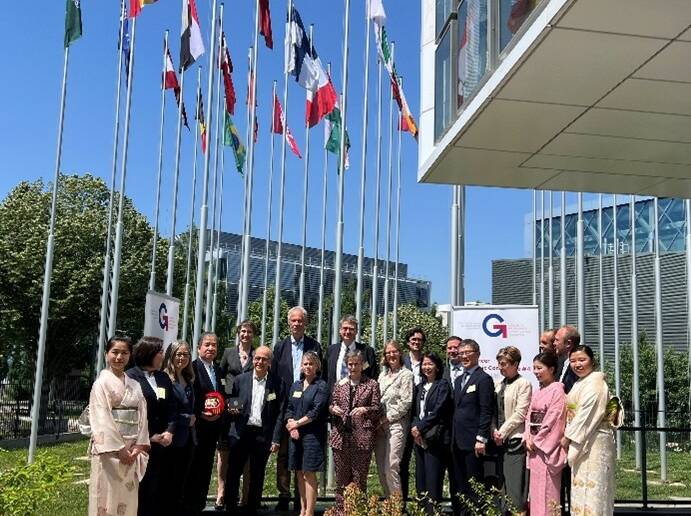
Members of the G7 Cancer Committee during the 4th strategic committee meeting
The fourth G7 Cancer Strategic Committee meeting, held on Tuesday 26 May in Lyon, marks an important milestone in this international initiative. Launched in May 2023 under the leadership of the National Cancer Institute, it brings together seven founding members, including some of the most advanced countries in the fight against cancer, and the International Agency for Research on Cancer (IARC), which joined the group in 2024 as an observer.
Chaired by Professor Norbert Ifrah, this committee has enabled a review of the work carried out during the first three years of the initiative’s existence, focusing on the four jointly defined priorities.
Over the past three years, this international cooperation has created a unique framework for exchange between major cancer agencies and institutions, with the aim of accelerating scientific collaboration, promoting the sharing of expertise, and developing joint initiatives on complex issues requiring enhanced international coordination. At the end of the meeting, Professor Norbert Ifrah officially handed over the chairmanship of the G7 Cancer to Dr Hiroyuki Mano, Director of the National Cancer Center Japan (NCC).
G7 Cancer: a three-year review reflecting the ongoing commitment of the experts involved
Since its inception, G7 Cancer members have structured their collective action around four priority areas, each led by a dedicated working group:
- international data sharing, using paediatric cancers as a model;
- cancers with a poor prognosis;
- inequalities in cancer care;
- cancer prevention.
This fourth Strategic Committee provided an opportunity to review the progress made by each of these groups and to take stock of the first three years of collaboration. These years have been characterised by a strong momentum, driven by the commitment of all the experts involved. The working groups have successfully created new spaces for exchange, reflection and scientific output through the organisation of webinars, the publication of articles and the preparation of events.
"International data sharing, using paediatric cancers as a model" group
Under the joint leadership of the Institut national du cancer (France) and the National Cancer Institute (United States), the group dedicated to the international sharing of paediatric cancer data has developed several pilot projects designed to facilitate the international analysis of data whilst ensuring its confidentiality.
Among the major advances is the development of the CONCORD Explorer project, an international platform providing access to paediatric cancer survival data covering nearly 180 countries. The group has also supported the development of federated query tools enabling international analyses to be carried out without the direct transfer of sensitive data. The results of this work have been published on the NAACCR website.
In parallel, an international mapping of paediatric data resources available in G7 Cancer member countries was carried out to identify the main existing registries and associated collection methods. This work aims to strengthen capacities for international scientific cooperation on paediatric cancers.
"Cancers with a poor prognosis" group
Work on cancers with a poor prognosis, for which the working group is co-led by the National Cancer Institute (France) and the National Cancer Centre (Japan), has made significant progress since the conference ‘Cancers with a poor prognosis: from resignation to revolution’, held in Paris in June 2025. This momentum has led to the establishment of an international scientific committee bringing together experts from the G7 Cancer countries to develop a common approach to these particularly complex cancers. The work focuses in particular on epidemiology, classifications, prevention strategies, early diagnosis and therapeutic prospects.An article entitled “Mapping National Definitions, Classifications, and Policy Approaches to Poor-Prognosis Cancers Across the G7 Cancer Initiative Countries”, focusing on the epidemiology and distribution of poor-prognosis tumours in the G7 Cancer countries, was published on 23 April in JCO Global Oncology. The scientific committee is now working on developing an international roadmap to identify priorities for research and scientific cooperation.
"Inequalities in cancer care" group
Under the joint leadership of the Canadian Institutes of Health Research and Cancer Australia, members of the group dedicated to cancer inequalities have reached a significant milestone with the publication of an article in The Lancet Oncology. This article is based on the report “Advancing Cancer Equity in G7 Countries: An analysis of Policy Levers”, which it authored and which is expected to be published later this year. The report is based on an in-depth literature review drawing on 53 policy frameworks and data sources, including national cancer control plans, national surveillance systems and registries, cancer outcome indicators, and international research on social determinants and health inequalities.
This analysis was supplemented by semi-structured interviews conducted with institutional representatives from each G7 Cancer member country. The aim of this work is to evaluate the strategies and initiatives implemented to reduce inequalities in cancer. The report examines, in particular, the main challenges encountered, the populations most exposed to inequalities in prevention, screening, access to care or outcomes, as well as how these issues are integrated into national cancer control policies, and proposes avenues for collaboration between G7 Cancer countries.
"Cancer prevention" group
Finally, the last group, dedicated to prevention, is co-led by Cancer Research UK in the United Kingdom, the German Cancer Research Centre (Germany) and the National Cancer Institute (United States).
Its aim is to bring together experts from different fields to share the knowledge and approaches that have led to positive developments in cancer prevention.
To this end, two international webinars were organised to facilitate exchanges between experts from G7 Cancer member countries on strategies for cancer prevention and early detection.
- The first one, focusing on lung cancer screening in 2024 (“Lung Cancer Screening in G7 Cancer Countries: Challenges and Lessons Learned”), brought together specialists involved in national screening programmes across the various G7 Cancer countries. Discussions focused on strategies for implementing the programmes, eligibility criteria for target populations, the integration of technological innovations, organisational challenges within healthcare systems, and the key lessons learned from national experiences.
- The second webinar, held in 2025 on precision prevention approaches (“Pathways to Precision Cancer Prevention”), brought together international experts from academia, institutions and industry to explore the conditions necessary for more personalised and effective cancer prevention. Discussions focused in particular on recent scientific advances, the use of data and biomarkers, drivers of innovation, the main scientific and organisational barriers, and concrete actions likely to accelerate the development of new prevention strategies.
The members of this group are currently working on the preparation of two strategic publications on cancer prevention and early detection, aimed respectively at the scientific community, public decision-makers and research funding bodies. This work aims in particular to identify the drivers likely to accelerate innovation in prevention, to promote the development of interdisciplinary approaches, and to broaden the profiles of the experts involved beyond the communities traditionally engaged in these issues.
The aim is also to enhance the scientific and strategic visibility of cancer prevention by fostering new collaborations between basic research, public health, data technologies, industry and health policy.
The National Cancer Institute hands over the presidency of the G7 Cancer to the National Cancer Center Japan
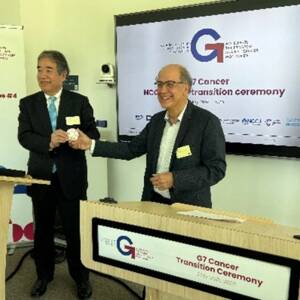
Dr. Hiroyuki Mano and Prof. Norbert Ifrah
during the transition ceremony.
After three years of chairmanship by the National Cancer Institute, during which the initiative was launched, structured and firmly established on the international stage, Prof. Norbert Ifrah, President of the Institute, officially handed over the chairmanship to Dr Hiroyuki Mano, Director of the National Cancer Center Japan (NCC).
Dr Mano outlined his vision for the next two years, placing a strong emphasis on strengthening collaboration among members, as well as a firm commitment to further raising the profile of G7 Cancer and establishing it as a key player in international cooperation in the fight against cancer. This transition reflects the maturity of an initiative which, in just three years under the chairmanship of the National Cancer Institute, has succeeded in creating new avenues for exchange, scientific output and reflection. It is now ready to open a new chapter under the leadership of the Japanese institution.
G7 Cancer member organisations
- Australia – Cancer Australia
- Canada – Canadian Institute of Health Research (CIHR)
- France – National Cancer Institute (INCa)
- Germany – German Cancer Research Center (DKFZ)
- Japan – National Cancer Center (NCC)
- United Kingdom – Cancer Research UK (CRUK)
- United States – Department of Health and Human Services, National Cancer Institute (NCI)
In 2024, the International Agency for Research on Cancer (IARC) joined the G7 Cancer as an observer.
Download our press release:
Press release_G7 Cancer: 3 years of international commitment by the world’s most advanced nations in the fight against cancer
PDF 1020 kB
Press Contact
Lydia Dauzet
Responsable des relations media et parlementaires - Institut national du cancer
- +33 (0)1 41 10 14 44
- +33 (0)6 20 72 11 25
- presseinca@institutcancer.fr
Juliette Urvoy
Chargée de relations presse - Institut national du cancer
- +33 (0)1 41 10 14 41